In my fall project I have 5 weeks to do research on the history and techniques of Trompe L'oeil. As I am studying, I am finding out that I know very little about the theories and processes of making a trompe L'Oeil painting.
in order to accomplish this art form, a student must have a solid grasp on Linear, oblique, and geographical perspective. in knowing this simple point, i have checked out books on perspective.
Perspective is the backbone of every painting. It is especially important to Trompe L'Oeil because the relies heavily on it's internat structure; it's skeleton, to create the illusion of realism.
In the next 5 weeks I will start writing about the history and Techniques that are required to accomplish this difficult form of painting.
always research and plan your projects,
and have fun
the art student
Showing posts with label art. Show all posts
Showing posts with label art. Show all posts
Wednesday, August 18, 2010


Monday, August 2, 2010
Last few points my instructor added in for 2d elements. Media/Technique/simplicity vs. complexity( unity)
Here are three last points that my instructor added to the 7 elements of 2d design.
1. media: The media that you use includes what you apply the media to and with, however the term " media" generally refers to what it is applied with. This will include Pencil ( carbon, graphite, lead, pastel, watercolor, charcoal), paint ( acrylic, oil, water color), ink ( wash, pen and ink). In the partial picture( Below) " Sea turtle cove" the media is Oil paint and is written "Oil on Canvas". Canvas is the second part of media. It describes what the media is applied to. It can include canvas, paper, silk, scratch board, linen, or anything else that it can be applied to.
2. Technique ( unity) : Technique refers to HOW the media is applied. This refers to techniques such as stippling, ink and brush, impasto paint, and ect. Technique also refers to unity. This gradation creates depth through the implication of atmospheric prospective.
3. Simplicity vs Complexity ( unity): In " Sea turtle cove" Impasto pointillism is gradiated into blending is also an example of Complexity gradiating into simplicity. this gradation helps create unity causing the atmospheric prospective to be believable.
In 2d art, all of the elements should be used to create unity in the composition.
Have fun
The art student
all material in this blog is subject to change at the advisement of my instructors.
1. media: The media that you use includes what you apply the media to and with, however the term " media" generally refers to what it is applied with. This will include Pencil ( carbon, graphite, lead, pastel, watercolor, charcoal), paint ( acrylic, oil, water color), ink ( wash, pen and ink). In the partial picture( Below) " Sea turtle cove" the media is Oil paint and is written "Oil on Canvas". Canvas is the second part of media. It describes what the media is applied to. It can include canvas, paper, silk, scratch board, linen, or anything else that it can be applied to.
2. Technique ( unity) : Technique refers to HOW the media is applied. This refers to techniques such as stippling, ink and brush, impasto paint, and ect. Technique also refers to unity. This gradation creates depth through the implication of atmospheric prospective.
 |
| "Sea turtle Cove" by Kimberlie Grady Oil on Canvas not the complete composition |
In 2d art, all of the elements should be used to create unity in the composition.
Have fun
The art student
all material in this blog is subject to change at the advisement of my instructors.
2 dimensional design, size/ Value/ Color/Texture
Size is the fourth element in 2d design. In a general sense, if placed side by side and the smaller object does not overlap the larger object, a larger subject will appear to move forward in the picture, and the smaller object will appear to recede. There are several other elements that can reverse this illusion.
The first is value and color. The discord of color are the complimentary colors on the color wheel. ( white/black, Red/green, Blue/Orange, Yellow/ Purple, and all the in between shapes)They are found opposite each other on the color wheel. It also refers to the Value and hue of the color.In general, and yes there are exceptions, warm colors( Red, orange, and yellow) move forward while cool colors ( green blue, and purple recede). Some of the exceptions to this theory deal with the hue of the color. For example if two greens are placed next to each other and one green has been slightly greyed out or dulled by the addition of the complimentary color, it will appear to recede. The greater the value the more forward an object will appear to move. If the smaller object is brighter than the larger object, it will appear to move forward in the composition.
The second is Texture. The discord in Texture refers to smooth and rough textures. Impasto ( thick paint) vs blended. If the smaller object has more texture in it, than it will appear to be in front of the larger object.
The first is value and color. The discord of color are the complimentary colors on the color wheel. ( white/black, Red/green, Blue/Orange, Yellow/ Purple, and all the in between shapes)They are found opposite each other on the color wheel. It also refers to the Value and hue of the color.In general, and yes there are exceptions, warm colors( Red, orange, and yellow) move forward while cool colors ( green blue, and purple recede). Some of the exceptions to this theory deal with the hue of the color. For example if two greens are placed next to each other and one green has been slightly greyed out or dulled by the addition of the complimentary color, it will appear to recede. The greater the value the more forward an object will appear to move. If the smaller object is brighter than the larger object, it will appear to move forward in the composition.
The second is Texture. The discord in Texture refers to smooth and rough textures. Impasto ( thick paint) vs blended. If the smaller object has more texture in it, than it will appear to be in front of the larger object.
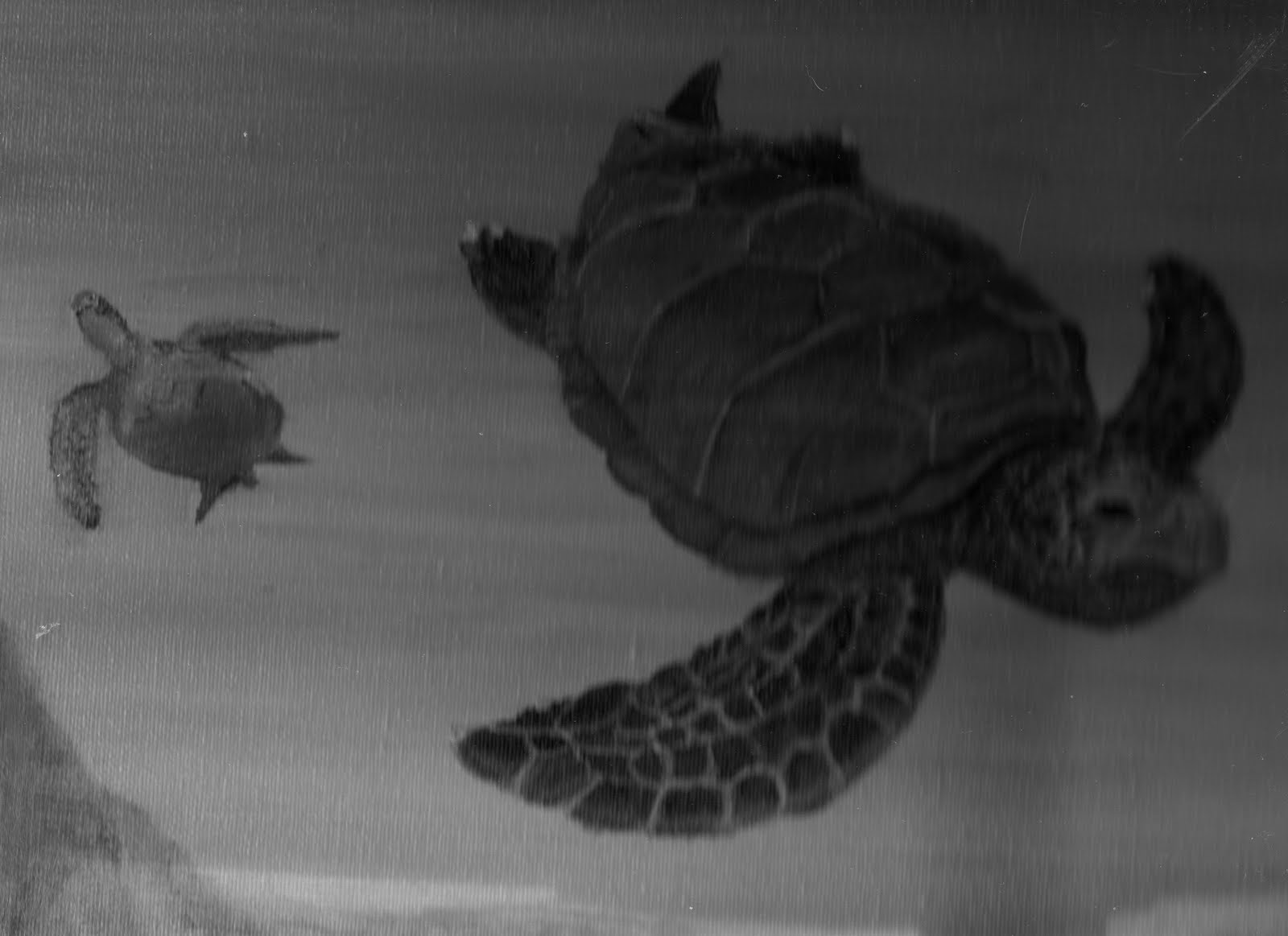 |
| Partial Picture " Sea Turtle Cove" Oil on Canvass by Kimberlie Grady Grey scale Notice how the larger turtle appears to be in front of the smaller turtle In addition to size, notice how the texture of the Larger turtle helps to strengthen this point |
 |
| Partial Picture " Sea Turtle Cove" Oil on Canvass by Kimberlie Grady Notice how the brighter color of the larger turtle places it in front of the greyed out smaller turtle |
 |
| Partial Picture " Sea Turtle Cove" Oil on Canvass by Kimberlie Grady Notice how the rocks in the foreground have more texture than the background The blending out of the background produces distance called Atmospheric ( or in this case water) perspective. Objects in the distance become less defined( less texture and color) Notice also how things in the distance are higher on the painting and closer objects are lower. All of the 7 elements, Line, direction, shape, size, texture, value, and color work together to make a well balanced composition. when creating a composition, consider carefully how each element plays against the others. Plan your compositions before beginning by changing each element. A photo copy machine works well ( or if you are going green a scanner/camera and computer) in experimenting with your composition. This preperation will also make your task more efficent by preserving time and materials ( and frusteration), and it will be more enjoyable. Have fun! The art student All information is subject to change by advisement of my instructors. |
Sunday, August 1, 2010
2d design, element 2 : Direction
Two dimensional design class is more about composition than the subject, or accuracy. When I took it, I was taught that there were 7 elements and 8 principles of design.
The main phrase in this lesson is DISCORD: The highest degree of contrast that can be obtained. ( white/black, large/small, rough smooth)
The second element is Direction:
The two Main discords in Direction are Vertical and horizontal. ( there are other directions such as diagonal). Direction pulls the eye through the picture.
 VERTICAL: Gives the impression of strength and power.
Figure 1: partial picture, ink wash on water color paper ( drawing 2, " ancient tree"by Kimberlie Grady ). notice how the tree rises up giving the feeling of aged power.


(DIAGONAL: imply action/movement)
Figure 3 and 4: Partial picture, " hummingbirds at dawn" oil on canvass, grey tones, by Kimberlie Grady. Notice how the hummingbird appears to be moving because of it's diagonal direction. The diagonal lines of the leaves also give movement to the dewdrops.
 (LINEAR LINES : pull the eye through the painting) In this picture the diagonal lines of the leaves also produce linear lines directing your eyes to the hummingbird.
I hope that this basic explanation of direction helps.
All information subject to change by suggestion of instructors.
The art student.
The main phrase in this lesson is DISCORD: The highest degree of contrast that can be obtained. ( white/black, large/small, rough smooth)
The second element is Direction:
The two Main discords in Direction are Vertical and horizontal. ( there are other directions such as diagonal). Direction pulls the eye through the picture.

Figure 1: partial picture, ink wash on water color paper ( drawing 2, " ancient tree"by Kimberlie Grady ). notice how the tree rises up giving the feeling of aged power.

HORIZONTAL: Gives the impression of peace, tranquility, and restfulness.
Figure2: Partial View " ancient tree" by Kimberlie Grady. Notice how the picture changed from powerful in the vertical view to tranquil in the horizontal view.

(DIAGONAL: imply action/movement)
Figure 3 and 4: Partial picture, " hummingbirds at dawn" oil on canvass, grey tones, by Kimberlie Grady. Notice how the hummingbird appears to be moving because of it's diagonal direction. The diagonal lines of the leaves also give movement to the dewdrops.

I hope that this basic explanation of direction helps.
All information subject to change by suggestion of instructors.
The art student.
2 dimensional design- Line drawings/shape
Two dimensional design class is more about composition than the subject, or accuracy. When i took it, I was taught that there were 7 elements and 8 principles of design.
The main phrase in this lesson is DISCORD: The highest degree of contrast that can be obtained. ( white/black, large/small, rough smooth)
Elements:
Look for the terms
Mechanical line vs Calligraphic line
Geometric shapes vs Organic shapes
1. Line:
 Mechanical lines are drawn consciously- printing your name is an example of a mechanical Line. Another example would be a line drawn with a ruler or a compass to make geometric shapes.
Image 1: Partial image of Kimberlie Grady's drawing 1 midterm " The Great Hall"Notice the geometric shapes.
 Calligraphic lines are drawn as one unit; intuitively, like when you write your name in script or cursive. Another example of Calligraphic lines are ORGANIC LINES/SHAPES. Organic lines are lines that are uneven and free handed drawn, like the outline of a tree.
Subscribe to:
Posts (Atom)